Showing posts with label Neurosensory Unit. Show all posts

Wednesday, 11 April 2012

Becoming the Bionic Woman – Part Two


If you haven’t read my original post Becoming the Bionic Woman, you may want to read that first.
Becoming the Bionic Woman

If you’ve read my post “Becoming the Bionic Woman”, you would know that I’ve been trialling the Phonak  Audéo S IX SMART (a micro Behind-The-Ear hearing aid). The trial was originally intended to be seven days however as it was the long Easter weekend, my audiologist very kindly let me borrow the device for an extra six days. Yay!

However, about eight days into the trial, the hearing aid battery died and I was abruptly thrust back into a world of partial hearing & decreased orientation. Suddenly I felt like an addict that needed to score. I was thinking, “Where can I get a hearing aid battery on a holiday weekend? Will the chemist be open? Will they have the battery I need?” Getting that battery became my number one priority. The shops were closed, so I spent an evening without a working hearing aid. Needless to say, I was strung out.

The following day I made a bee line for the chemist and the sales lady found a new battery that matched the one in the hearing aid. I put the hearing aid back in and sighed a relief to be “bionic” again. However the next day much to my surprise I heard the distinctive “ding, ding” sounds that the hearing aid was running out of power again. “No!!” Although the replacement battery was a fit, it was a lesser strength one intended for watches & other small medical devices. I needed a longer life battery.

So back to the chemist I went again only to be informed that they were out of stock of hearing aid specific batteries, so I bought up a few regular ones to get me through the long weekend.

Anyway, today my trial was up. It was time to return the device and decide whether to order a custom hearing aid or not. “You don’t know what you’ve got until it’s gone” is the phrase that comes to mind at this point. The answer to my decision was a clear yes.

I had though one obstacle in my way… money. Living in the post GFC world that we do, my credit card is fairly maxed out. So I wasn’t sure that I could currently afford the Phonak Nano Ambra I was hoping to purchase (approx. AUD$4,500 fitted).

My audiologist, Michelle Nicholls, at the Neurosensory Unit in Brisbane mentioned that Phonak is owned by Sonova Group which also owns Unitron. According to Michelle, Unitron will be launching a comparative hearing aid on April 30 2012. Unitron’s Quantum micro CIC can be fitted with either 20, 12 or 6 channels, so it should offer a good alternative to the Phonak Nano Ambra for my moderate hearing loss.

As I have already registered with Australian Hearing (a Department of Human Services) for a partial subsidy to help pay for a hearing aid, the new Unitron Quantum micro CIC (20 channels) might only set me back around AUD$3,200 (including fitting & government subsidy). So potentially there’s a good saving to be made. Bearing this in mind I thought it best to wait until the end of the month before deciding on whether the Phonak Nano Ambra or the Unitron Quantum micro CIC would be better suited to my needs.

Not wanting to waste an audiology appointment, Michelle took a putty imprint of my left ear canal in preparation for ordering a custom fitted hearing aid. That way once I have all the facts, I can just ring up to confirm & pay, then wait for the device to be custom made then delivered to my audiologist for fitting.

Just in case you’re wondering how they make a custom fit hearing aid, here’s how. After the putty imprint of the ear canal is taken, the mould is scanned in house by a 3D scanner, the image is then sent online to the manufacturer. The scanned image is then adjusted and outputted in plastic by a 3D printer. Once it’s cleaned up, a technician fits the plastic shell with the technology. That’s the general idea. I’m sure it’s a more specific process than that. It’s amazing technology.

I’m so glad to be living in “THE FUTURE”. Yes indeed… we do have the technology. 

HAVE YOU HAD A SIMILAR EXPERIENCE? SHARE YOUR COMMENTS BELOW.

Connect with others who have hearing loss
Phonak has started a new online community initiative called Hearing Like Me
It supports those touched by hearing loss through the exchange of experiences. Check it out here: 

Read about the Siemens 3D Scanner which Digitizes Ear Impressions for Customized Hearing Aids

Australian Hearing is a Department of Human Services which provides a choice of hearing aids - from fully subsidised devices through to mid-range, high-range and premium devices. They offer hearing devices made by manufacturers such as Siemens, Bernafon, Phonak, Oticon, GN Resound, Widex and others. Eligibility applies (see below link).
Find out if you’re eligible for Australian Hearing here:

NEWS RELEASE - Unitron Announces Tiniest Quantum Ever 
Quantum 20/12/16 Features

Wednesday, 4 April 2012

Becoming the Bionic Woman: Hearing Technology for Ménière's Disease


It’s been many years since I’ve watched an episode of The Bionic Woman. As a child I would be glued to the TV enthralled by the super human qualities of character Jaime Sommers, a tennis pro that nearly died in a skydiving accident only to be “re-built” with a bionic right ear, a strengthened right arm and enhanced performance legs. The catchphrase was, “We can rebuild her… we have the technology”.

As much as I would love to be able to crush a tennis ball with my right hand, or run up to 60 miles per hour (about 96km), I would quite happily settle for the bionic ear. Thanks to Meniere’s Disease I’m more like some character from the Beverly Hills Hillbillies with an ear trumpet, “What’s that sonny? Speak into the ear horn!!”

But luckily this isn’t 1976. We’re living in “THE FUTURE”, so what cost six million dollars in the seventies would surely be available and affordable now. Right? Well not quite.  Thirty six years on a top-of-the-line hearing aid will put you back about AUD$4,300 to $5,000 (for a single aid, not including fitting). It’s not the implanted variety that the Bionic Woman had, but its close.

Last week I went to my hearing specialist, at the Neurosensory Unit in Brisbane, for an audiogram specifically to fit me for a trial hearing aid.

My audiologist, Michelle Nicholls, took me through the usual audiogram (anyone with Meniere’s would be familiar with this test). After the test she asked me what type of outcome I was looking for; specifically if I wanted to hear a wide range of sounds or primarily just speech. Apparently older recipients of hearing aids prefer to hear speech without the addition of the ambient noise that surrounds us.

As a young-ish person with Menieres, of course I wanted to be able to hear speech better but I also wanted to be able to hear music better and all the richness of the sounds that surround us. I wanted to feel more a part of my surroundings as I had before I started to lose my hearing. Also I wanted to be better able to orientate myself with sound. ( If I ask somebody in another room where they are, they invariably say, “I’m here!”. “Here? Where exactly is here?” “I can’t tell anymore because I’m going deaf in one ear and can’t pinpoint where “here” is.”) But most of all I wanted to be able to hear the very low frequency pitch, like the low, guttural sounds of my cat purring (between 25 and 150 Hertz). Once I have that sound back I’ll be happy.

Based on my requirements and my moderate, unilateral hearing loss diagnosis, Michelle selected a hearing aid she believed would be suitable. She selected the Phonak  Audéo S IX SMART (a micro Behind-The-Ear model) for trialling with the expectation that if it worked well I could look at getting a Phonak Nano Ambra (a Custom In-The-Ear model) which essentially has the same features as the S IX SMART but is neatly concealed in the ear canal.

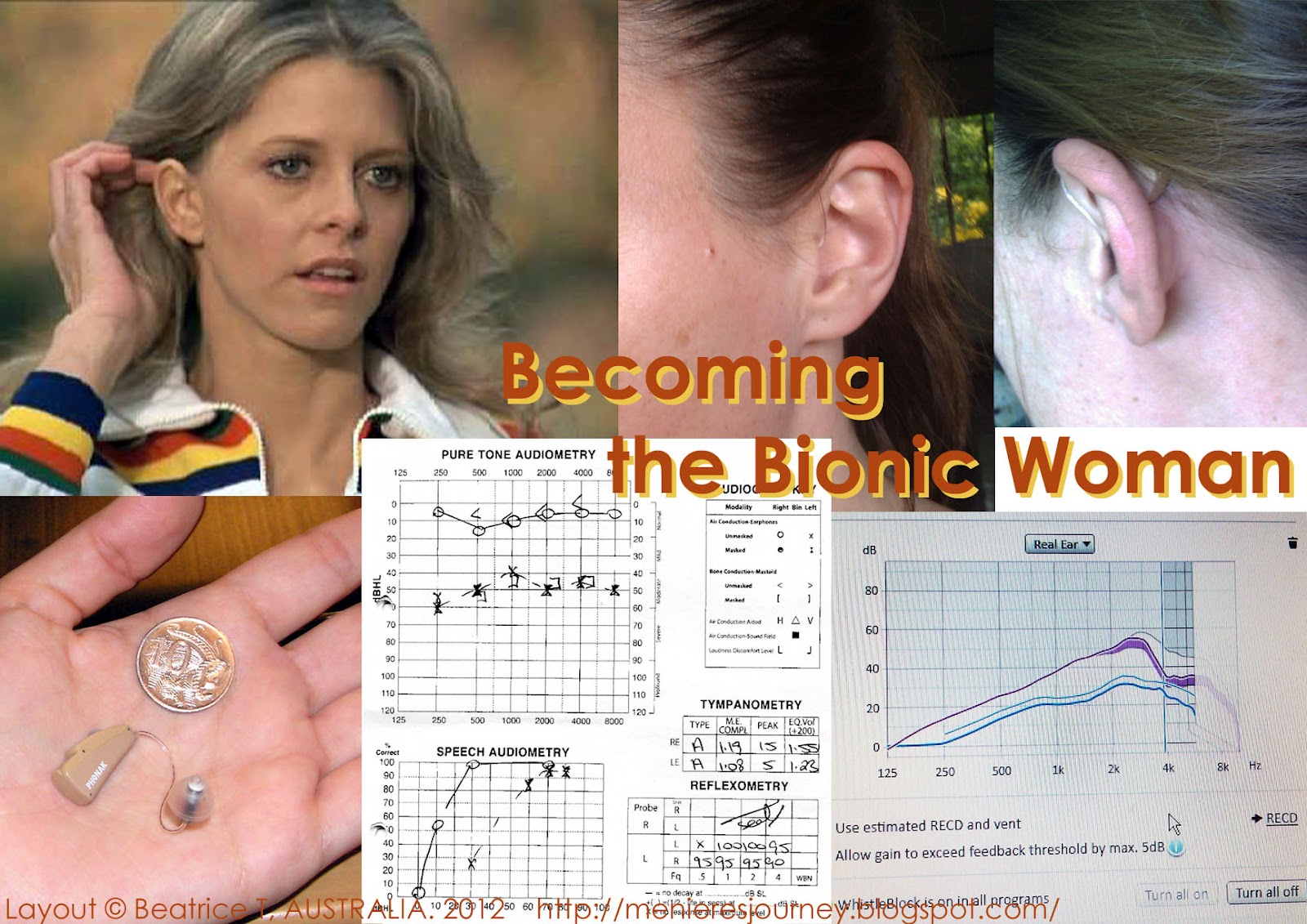
I tried the Phonak  Audéo S IX SMART on my left Meniere ear and Michelle took me through the Real Ear Test. She asked me questions, I provided her with feedback, then she would make some adjustments through her computer (see bottom right pic above) and we’d repeat the process. Once we were satisfied that I had the optimum level, I was released back into the wild with my “bionic” ear.

On my way out through the reception I was suddenly very aware of the sound around me. It felt like somewhere in the room there was a concealed microphone and speakers, like a subtle PA system. I heard the whir of the ducted air conditioner above, which I had not previously noticed. So this is what it’s like to be bionic.

In the busy café downstairs I approached the cashier to place my decaf coffee order. I felt so much more tuned into what was happening; people chatting behind me, music coming from the speakers above and most importantly the cashier asking me to place an order, which I did. I could feel myself smiling because of my bionic secret. I was mindful to compose myself so as not to appear weird but as I looked down I “heard” the cashier ask me if I wanted a receipt. I looked up and with a beaming smile I said, “Yes. Yes I would love a receipt.”  Knowing that my fascination for the rediscovered world of sound was spilling over, I came clean and said, “I’ve just been fitted with a hearing aid, so I’m feeling pretty pleased at the moment because I can hear things I haven’t heard for a while.” The cashier was inquisitive and tried to spot the device in my ear saying, ”It’s not very noticeable”. Yay! (See pictures above.)

Over the past week of trialling the Phonak Audéo S IX SMART I’ve had similar moments of awe but have remained more contained in my outward persona. I even went on a first date with a fellow who was none the wiser of the presence of hearing assistance, which was great because that’s not the sort of conversation I want to have on a first date. I’ll save that for the honeymoon ;-) (Just kidding folks.)

I haven’t been wearing the hearing aid all day. Obviously it can’t be worn in the shower or while sleeping in bed. When not in use I’ve kept the device next to my bed. In the morning I click the battery hatch door into place and put the device in my ear where it stays until about late afternoon. It’s been great for chatting with my flatmate, watching television and listening to music (without headsets as it would get in the way, although there is a Phonak accessory for that). It’s been particularly good for being out and about, shopping, in cafes, and hearing ambient noise to help orientate myself. I’ve even had a few “bionic” moments, hearing conversations normally out of range.

On the negative side, I tried to have a phone conversation using the Meniere ear and although there was some improvement I found it easier just to revert to my good ear. I also find that by mid-afternoon I’ve been taking the hearing aid off for a while as it begins to feel heavy (like wearing chandelier earrings for a few hours) even though it weighs next to nothing. Also if I brush my hair back behind my ear with my fingers there is a prominent microphone sound, like if you were to brush your hand over a regular microphone (“testing… one, two, three”). The same thing occurs when wearing sunglasses. That can be a little annoying however this wouldn’t be an issue with a Custom In-The-Ear model. And last but not least, I haven’t found it particularly effective in hearing the low frequencies of a cat purr (sigh!). That could be partly to do with the position of the microphone behind the ear, so an In-The-Ear model might be better for that.

Overall I feel it has been a beneficial experience. I’ve found that although my hearing is not back completely, there is enough of an improvement to make daily activities more tolerable and even enjoyable. Now all I have to do is find the funding for the Phonak Nano Ambra. Oh, well… at least it’s not $6million.

HAVE YOU BEEN FITTED WITH A HEARING AID BECAUSE OF MENIERE’S DISEASE? IF SO, SHARE YOUR EXPERIENCES BELOW.

WATCH Lindsay Wagner as The Bionic Woman

Bionic Woman Intro

Bionic Woman's Ear Problem

MORE ABOUT THE HEARING AIDS BELOW:

Phonak Audéo S IX SMART 
Features & Benefits
Acoustically Optimized Vent (AOV) - Minimum occlusion
DuoPhone - With the push of a button, the phone signal is heard in both ears
EchoBlock - Understand well in echoey environments
FlexControl - Easy interaction with the hearing system
FlexVolume - Controls that allow the wearer to easily make targeted adjustments
NoiseBlock - Premium comfort in background noise
QuickSync - Control both instruments with one touch
Real Ear Sound - Natural sound orientation
SoundFlow - Continuous and instant optimization to all environments
SoundRecover - Awareness of the sound environment and listening pleasure
SoundRelax - Eliminating annoying sounds
WhistleBlock - Feedback free hearing
WindBlock - Suppresses wind noise
ZoomControl - Ability to choose the hearing focus 
WaterResistant - Water, sweat, moisture and dust resistant! 
StereoZoom - In an extremely noisy situation where you want to communicate with just one person, StereoZoom can zoom in even closer and reduce noise even further. 
Auto ZoomControl - When you cannot easily face the speaker, e.g. in a car, auto ZoomControl can zoom to either side and backwards for effortless understanding.
UltraZoom Premium - In noisy situations with several people talking around you, UltraZoom automatically zooms to the voices coming from the front. Noise from the side and back is reduced.

Phonak Nano Ambra
Features & Benefits
Acoustically Optimized Vent (AOV) - Minimum occlusion
DuoPhone - With the push of a button, the phone signal is heard in both ears
EchoBlock - Understand well in echoey environments
FlexControl - Easy interaction with the hearing system
NoiseBlock - Premium comfort in background noise
QuickSync - Control both instruments with one touch
Real Ear Sound - Natural sound orientation
SoundFlow - Continuous and instant optimization to all environments
SoundRecover - Awareness of the sound environment and listening pleasure
SoundRelax - Eliminating annoying sounds
WhistleBlock - Feedback free hearing
WindBlock - Suppresses wind noise
ZoomControl - Ability to choose the hearing focus 
WaterResistant - Water, sweat, moisture and dust resistant! 
StereoZoom - In an extremely noisy situation where you want to communicate with just one person, StereoZoom can zoom in even closer and reduce noise even further. 
Auto ZoomControl - When you cannot easily face the speaker, e.g. in a car, auto ZoomControl can zoom to either side and backwards for effortless understanding.
UltraZoom Premium - In noisy situations with several people talking around you, UltraZoom automatically zooms to the voices coming from the front. Noise from the side and back is reduced.

Accessories and FM’s
Phonak have optional wireless accessories for TV, telephone, MP3 player, GPS and computers such as ComPilot, TVLink S, PilotOne and iCom – TVLink.