Sunday, 20 May 2012

Salovum & SPC-Flakes: How Antisecretory Factor (AF) Can Decrease Meniere’s Disease Vertigo


One of my wonderful readers (Kim from Cairns) asked me if I knew anything about two products that she’d heard may assist with Meniere’s Disease vertigo: Salovum & SPC-Flakes.

I must say that I’d never heard of either product, so I’ve spent the last few days extensively searching news articles, press releases, PubMed articles, IP patents & corporate websites (in languages including: Swedish, Norwegian, and English) and this is what I came up with.

It’s a lot of information, but considering how hard it was to find anything on the products, I thought it best to just get as much as possible on one page. Readers of this post will then be able to make an informed decision when considering adding either or both of these products to their Meniere’s management program.

In Brief: What are Salovum® & SPC-Flakes®?

Salovum® & SPC-Flakes® are genetically modified foods classified as “food for special medical purpose”. Both products deal with a protein called Antisecretory factor (AF) which normalizes fluid and ion transport across cell membranes in the body's cells. (Read more about Ions below.)

Salovum® is a source of protein AF in the form of the concentrated egg yolk powder B221®, while SPC-Flakes® is a specially produced oatmeal engineered to stimulate the body’s own production of protein AF.
 

What is Antisecretory Factor (AF)?

Antisecretory factor (AF) is a protein secreted in plasma and other tissue fluids in mammals with proven antisecretory and anti-inflammatory activity; its immunohistological distribution suggests a role in the immune system. The expression level and the distribution of AF protein are altered during an immunological response.
Note: If you haven’t already read my post on PNI & Herpes Viruses which discusses the immunological response and how I believe it contributes to Meniere’s Disease, I recommend you read it. Ménière’s Disease: Is Psychoneuroimmunology (PNI) & Herpes the Cause?

Antisecretory factor (AF) (or ASF as it was abbreviated in the 1980’s) was discovered by Swedish Microbiologists / Immunologists Stefan Lange & Ivar Lönnroth in the early 1980’s. Most of these early studies focused on cholera associated diarrhoea, as well as post-weaning diarrhoea in piglets.

Some of AF’s uses are for conditions caused by a traumatic, auto-immune or degenerative disorders. 

AF is also claimed by the patent owner to be useful for:
“…inducing improved rescue of injured or diseased nervous tissue, proliferation, apoptosis, differentiation and/or migration of an embryonic stem cell, adult stem cell, progenitor Cell and/or a cell derived from a stem cell or progenitor cell, for treating a condition characterised by or associated with loss and/or Gain of cells. In a preferred embodiment, the condition is a neurotrauma or a condition or disease of the CNS and/or PNS and/or ANS, for example, Alzheimer’s disease.”

Note:
I think it’s interesting that Antisecretory factor (AF) can inhibit diarrhoea. A number of people I have met who have Meniere’s Disease have stated that they have experienced diarrhoea in conjunction with a Meniere’s attack. On a few occasions I have had the need to stagger/run to the restroom during acute Meniere attacks to deal with vomiting & diarrhoea.

Most ENTs &GPs are not aware that diarrhoea can be a symptom during a Meniere’s attack. Once I was admitted to a major public hospital emergency room in Brisbane (Queensland) during an acute Meniere’s attack (4+ hours). I informed the young doctor of my symptoms. Upon hearing that one of the symptoms was diarrhoea he promptly dismissed my claim that I was having a Meniere’s attack and foolishly diagnosed me with food poisoning, saying that diarrhoea is not a symptom of Meniere’s attacks. This was about eight months after my official Meniere’s Disease diagnosis, so I knew the difference between a Meniere’s attack & food poisoning. That was the first & last time I went to that hospital for treatment.

Who Makes Salovum® & SPC-Flakes®?

Salovum® & SPC-Flakes® are registered trademarks of a Swedish company, Lantmännen AS-Faktor AB.

According to Lantmännen AS-Faktor’s website, they develop and produce highly refined products from Swedish farms. Some of the research and development is based on the Swedish discovery of a protein called AF. The company has operations in the areas of medical food and special animal feeds. The company also engages in extensive research in pharmaceutical development with several high-profile Swedish universities and researchers.

Products developed by Lantmännen AS-Faktor include Trygge, SPC-Flakes, Magiform and Salovum.

Many of the company's products are patent-protected, for such purposes as for the use of malted cereals or egg yolk for producing a food or medical food for the treatment and/or prevention of a condition associated with or characterised by a pathological loss and/or gain and/or rescue of nervous tissue.


What is Salovum®?

Salovum® egg yolk powder contains protein with antisecretory properties in a much higher (500 times) concentration than found in normal hen eggs. This is achieved by feeding hens with specially-processed cereals, capable of inducing production of protein with antisecretory properties in the yolk, from which an egg powder is produced.

Salovum® can/has:
·         be used in the acute phase or as the beginning treatment of patients with a presumed low amount of AF.
·         normalize fluid flow. This is of clinical significance within bowel diseases, diarrhea, Mèniére and Mastitis.
·         also been shown to have an anti-inflammatory effect which was seen in studies of inflammatory bowel disease (IBD) like Colitis Ulcerosa and Crohn’s disease.

Although Salovum appears to be safe for short-term studies, I could not find any information on potentially long-term adverse effects.

Description: Food for special purposes.
Application: Meniere and secretory bowel disorders.
Important: Salovum should be applied in consultation with your doctor or dietician. Recommended for children over 1 year and adults. Must not be given parenterally.
Dosage: 1 serving 3 times daily or as your doctor's instructions. The recommended dose should not be exceeded.
Preparation: Salvoum dissolved in cold liquid / juice. Best results are obtained with the juice. Salovum can be sprinkled on bread or stirred into an omelette.
Warning: People with egg allergies should avoid Salovum.
Further information: Contact your doctor or dietician.
Packaging: 1 pack of 25 sachets x 4 g each

Excerpt from:
CLINICAL STUDIES AND CASE REPORTS:
The AF Protein a Clinical Innovation of Endogenous Origin

Treating Mb Ménière with Egg yolk powder B221®
As the study above showed, there are some patients that are non-responders when treated with AF inducing specially processed cereals (SPC). Due to the positive results of Egg yolk powder B221® in the treatment of secretory diarrhoea, it was tested on Ménière’s disease as well.

AF-inducing SPC was tested during a two month period on a 67 year old woman with a thirty year history of Mb Ménière. She had frequent attacks lasting for 8 hours up to three days with nausea, vertigo, diarrhoea and vomiting. When the SPC diet did not improve neither the duration of the attacks nor the severity, she was given Egg yolk powder B221® at a dose of 2 g five times daily to see if this exogenous administration of AF in high concentrations could offer positive clinical results.

On day 18 of the treatment the patient was completely relieved of her symptoms and her Ménière status was improved from 6 to 1 (American Academy of Otolaryngology). After six months of symptomatic relief the patient lowered the dosage of Egg yolk powder B221® with the result that her attacks with rotatory vertigo returned. Returning to the original dosage level led to immediate improvement without the need for further medication. No improvement, however, could be seen on her right-sided hearing impairment.

The results show that patients who do not respond to treatment with AF-inducing cereals can be favourably treated with Egg yolk powder B221®. To stimulate the body’s own production of AF it is likely that an introduction of AF-inducing cereals in connection with or as a follow-up to Egg yolk powder B221® treatment will be found valuable.

Hanner, Jennische and Lange, Antisecretory Factor: A clinical innovation in Ménière’s disease?, Acta Otolaryngol, 2003; 123:779-780


What are SPC-Flakes®?

SPC-Flakes® (specially processed cereals) are specially produced oatmeal made with a unique and patented production method. SPC-Flakes® are used as  ”maintenance” treatment to stimulate the body’s own production of protein AF.

In 1998 the Sahlgrenska University Hospital undertook a study of SPC-Flakes on patients with Meniere’s Disease with successful results (see pages 6 & 7 of the PDF).  

SPC-Flakes® can/have:
·         normalize fluid flow. This is of clinical significance within bowel diseases, diarrhea, Mèniére and Mastitis.
·         also been shown to have an anti-inflammatory effect which was seen in studies of inflammatory bowel disease (IBD) like Colitis Ulcerosa and Crohn’s disease, rheumatoid arthritis and mastitis.

SPC Flakes should be used in consultation with a physician or clinical nutritional physiologist.

Mechanism of action: Stimulates the body to increase production of AF (Antisecretory factor), a protein that normalizes fluid and ion transport across cell membranes in the body's cells.
Dosage: 1g/kg body weight or the physician's recommendations. (Therefore a person weighing 80kg might take 80gms of SPC-Flakes. Should be used (2 to 3 times) a day. 1 ml of SPC-Flakes is equivalent to approx. 50 g
How do you eat SPC-Flakes:   SPC-Flakes can be eaten plain, for instance buttermilk or yoghurt. SPC-Flakes may be cooked like porridge: 1 cup SPC-Flakes boiled for 3 minutes with water and a pinch of salt. Let the porridge sit for a few minutes before it is eaten, add raisins and/or cinnamon for taste. Can be used in baking.
Warning:  Must be eaten with caution in gluten allergies (see more information on a gluten free option below). 
More information: Contact your doctor or clinical nutritional physiologist.

Excerpt from:
CLINICAL STUDIES AND CASE REPORTS:
The AF Protein a Clinical Innovation of Endogenous Origin

SPC-treatment of Ménière’s disease
Since the AF products have such favourable results in secretory diseases of the gut, it was hypothesised if this could also be applied to other conditions where fluid imbalances are of importance or can be suspected.

After several pilot studies a trial was performed at Sahlgrenska University Hospital under the guidance of Per Hanner. The aim of the study was to examine if AF could be induced in cases of pathologically elevated pressure of the inner ear and to study if stimulated AF production can lessen the clinical symptoms of Mb Ménière patients.

24 patients with Mb Ménière, with a duration between ten months and thirty years, were included in the study. The patients received, in addition to their regular medication, a SPC-diet at a dosage of 1 g/kg body weight a day, for 2-4 weeks. The patients kept a diary over their subjective and auditive symptoms, and frequency, duration and characteristics of vertigo. Baseline tone and speech audiometry and neurological status was determined as well as AF plasma level before and after the treatment period.

The concentration of AF in plasma varied between 0-0,6 units before treatment and 0-1,7 units after treatment. 83% of the patients showed an increase of AF above 0,5 units after treatment, the level at which clinical improvement of secretory diarrhoea has been shown in previous studies. In 17% of the patients, little or no increase of AF was seen and they did not experience any improvement of the clinical symptoms either. In 29% of the patients a significant increase of AF was registered but without clinical response.

In 12,5% of the patients hearing ability returned to normal levels and vertigo was completely eradica-ted. In 54% vertigo was improved. The improvements noted ranged from complete remission to remaining light and diffuse feelings of dizziness without previous attacks of rotatory vertigo.

Symptoms were either reduced or in complete remission in more than half of the patients with severe Ménière’s disease who were treated with a simple, inexpensive and well tolerated treatment. Some of the patients, however, did not seem to have the ability to produce AF. They may need AF inducing cereals in higher concentrations or for longer treatment duration.

Hanner, Jennische, Lange, Lönnroth and Wahlström, Increased antisecretory factor reduces vertigo in patients with Ménière’s disease: a pilot study, Hearing Research, 2004; 4803:1-6

Can People with Gluten Intolerances Eat SPC-Flakes®?

No, however Lantmännen AS-Faktor has joined forces with Svalöf Weibull (SW) and Lantmännen Mills to formulate a process chain which allows rolled oats to be produced without the addition of wheat, rye or corn, in order to cater for people with a gluten intolerance. These 100% rolled oats will be sold by Semper - one of the largest players in gluten-free products in Sweden.

Some IKEA stores stock Semper food products, so next time you’re at an IKEA (the small goods section outside the checkout area) ask if they stock an AF SPC 100% oat product by Semper. They may not know what you’re talking about but it doesn’t hurt to ask.

I’m not sure if this link is Semper’s AF SPC 100% oat product, but you can always email the company to ask. Semper Gluten Free Products


Where Can You Buy Salovum® & SPC-Flakes®?

I have only found two online stockist of Salovum® & SPC-Flakes®. POA Pharma Scandinavia and an independent distributor.

Considering the cost of the products & their weight, I think that Salovum® would be the most cost effective product for international residents to start with. Salovum® offers more “bang for the buck” because it is more highly concentrated. If you live outside of Scandinavia, you might need to order 2 or 3 boxes of SPC-Flakes® just to get you through two weeks, and I’m sure international postage & handling costs would make this an expensive endeavour.


POA Pharma Scandinavia

Buy Salovum®
25 x 4gm sachets
120,00 Euro. (currently AUD $156) Shipping expenses will be added. 
Note: The above study used 10gms daily (2gms x 5 times). Based on this you might need 300gms (3 boxes) to try the product for one month. It's not cheap, but it could make all the difference if you've exhausted other Meniere's management options.

450 g box 
12,00 Euro. (currently AUD $15.60) Shipping expenses will be added. 
Note: The above study used 1gm per 1kg of body weight daily. Based on this an 80kg person woiuld need 80gms daily. Over 2 weeks 2.5 boxes would be needed as there would only be 5.5 servings per box for a person weighing 80kg. This would be cheaper to try than the Salovum (although postage & handling would likely be more expensive due to the bulk of the product), however it would likely be less effective. Still, it's an option.

Independent Distributor
Note: Use the Google translation function to view these pages in English.

Buy Salovum®
            No price currently listed.

Norwegian Kr. 99.00 (currently AUD $16.85)


MORE INFORMATION:

Product Info Contacts:

POA Pharma Scandinavia
Phone: +46 31 788 0599
Email:  info@poaab.com

AS-Faktor

Lantmännen AS-Faktor

Semper


What’s an Ion & What’s its Role in the Inner Ear?

An Ion is an atom or molecule in which the total number of electrons is not equal to the total number of protons, giving it a net positive or negative electrical charge. Ions allow a current to pass between electrodes in a solution when an electric field is applied.

Water is comprised primarily by the following ions:
Cations (positively charged Ions) – Calcium (Ca²+), Magnesium (Mg²+), Sodium (Na+) & Potassium (K+)
Anions (negatively charged Ions) – Bicarbonate (HCO3-) / Carbonate (CO32-), Sulphate (SO42), Chloride (Cl-)

Those with Meniere’s Disease reading this will recognise the mention of Sodium & Potassium, as these ions make up the Perilymph and Endolymph that regulate the electrochemical impulses of the inner ear hair cells.

Sodium (Na+) is the main Cation in Perilymph. Potassium (K+) is the main Cation in Endolymph. The electric potential of Endolymph is ~80-90 mV more positive than Perilymph due to a higher concentration of Potassium compared to Sodium .

For more on Ions read this Wikipedia page HERE


PubMed Articles

Antisecretory Factor (AF)

2003

European Patent for NOVEL USE OF ANTISECRETORY FACTOR


Antisecretory factor-inducing therapy improves the clinical outcome in patients with Meniere’s disease.pdf


ANTISECRETORY FACTOR AND ITS BIOLOGICAL ACTIVITIES PDF


SPC-Flakes®

2010
Italy

2010
Sweden

Salovum®

2011
Bangladesh & Switzerland

2007
Pakistan

 Disclaimer
This website contains general information about medical conditions and treatments. The information is not advice, and should not be treated as such. The medical information on this website is provided without any representations or warranties, express or implied. Beatrice T via the Inner Ear Journey blog makes no representations or warranties in relation to the medical information on this website. Without prejudice to the generality of the foregoing paragraph, Beatrice T via the Inner Ear Journey blog does not warrant that:
- the medical information on this website will be constantly available, or available at all; or
- the medical information on this website is complete, true, accurate, up-to-date, or non-misleading.
You must not rely on the information in this document as an alternative to medical advice from your doctor or other professional healthcare provider. If you have any specific questions about any medical matter you should consult your doctor or other professional healthcare provider. If you think you may be suffering from any medical condition you should seek immediately medical attention.
You should never delay seeking medical advice, disregard medical advice, or discontinue medical treatment because of information on this website. Nothing in this medical disclaimer will limit any of our liabilities in any way that is not permitted under applicable law, or exclude any of our liabilities that may not be excluded under applicable law.

HAVE YOU USED SALOVUM &/OR SPC-FLAKES TO CONTROL YOUR MENIERE’S DISEASE? If so, share your comments below.

Friday, 4 May 2012

Imagine… What it’s like to Have Meniere’s Disease

You know it's funny. When I tell people I have Ménière’s Disease they usually respond by saying, "what's that" or "never heard of it". No one has ever asked me what it's like to have Menieres. If they did I would describe it thus.

Imagine that you have one blocked ear. Feel that sensation. Sense the fullness. Strain to hear the haziness of muted sounds. Feel what it's like not being able to hear in an ear.

Now imagine that in addition to the blocked ear, a couple of crickets have somehow crawled into your ear & are making a constant white noise. Hear it? Hear the shhhh, buzzing or hissing sounds?

Now imagine that as well as the blocked ear & the crickets, you have a head cold or you’re just a little hung over so everything is a more complicated than usual. You feel mentally and physically drained, and need more time to accomplish the simplest of tasks. Light might affect you more. You might start bumping into things and have trouble thinking. You might even feel that it's unwise to drive. You feel it? Feel the fogginess?
 
Now imagine that adding to the blocked ear, the crickets & the hangover you now find yourself on a boat out at sea, rocking up & down, left & right. You look to the horizon to get your bearings but it's moving. So you feel hazy or perhaps nauseous. The waves go up & down; left & right. Can you imagine how that feels? (see video above)

Now to make matters worse you learn that you will likely never, ever get off this rocking boat. That's right.

Now imagine that you are alone on this boat and that all of your friends, family & work colleagues are back on dry land going about their lives with normal hearing & balance; cricket & hangover free (okay, maybe not hangover free). They don't understand what you're going through. Can you feel the isolation?

Now if you are very lucky, one day, after potentially years afloat, the boat you’re on will briefly go back to dry land and dock at a port called Remission. There you will have a chance to stand on solid ground, hear blissful silence, feel unblocked ears & experience hangover-free clarity of mind. And you know what that will feel like? Pure, unadulterated heaven.

While in Remission you will radiate from the sensation that everything good on this earth has been rolled up into one awesome, life changing, musical inspiring experience. For a few weeks or months you'll rediscover your smile, every breath will invigorate you, and everything around you, including the previously banal, will glow will be unabashed glory. Can you even begin to imagine that??

A sense of peace that comes from just the simplicity of good health, one you’ve likely never even noticed before, will come over you and suddenly life will be bathed in hope & optimism for the future... until, one day, you begin to notice your hearing going and the blocked ear coming back. Within days the crickets are chirping again, and before you know it you're on that boat again, alone, heading indefinitely out to rocky seas with no knowledge of when, or if, you will return to port. Now, can you imagine it? Feel the loneliness, disappointment & uncertainty of your future? It doesn't feel great.

That's one example of what it's like to have Meniere's Disease, and that's without describing the addition of random vertigo attacks. I'll save that description for another cruise.

HOW WOULD YOU DESCRIBE THE EXPERIENCE OF MENIERE’S DISEASE? Please share your experience in the comment section below.

Wednesday, 25 April 2012

Acyclovir, Famciclovir & L-Lysine: Can Anti-Viral Medication for Herpes Help Control Meniere’s Disease?


As mentioned in my page Ménières & HERPES, there are many published medical studies suggesting a link between Meniere’s Disease and Herpes Viruses.

Acyclovir & Famciclovir

Acyclovir (also known as Aciclovir) helps to stop herpes viruses from spreading to other cells. It is used to treat chickenpox, shingles, and genital herpes. Acyclovir is available as tablets, capsules, an ointment, a suspension or as an injection. Acyclovir can be used to treat recurrent outbreaks.

Like acyclovir, Famciclovir can help prevent herpes viruses from spreading to other cells. It is available as a tablet for the treatment of cold sores (herpes simplex 1) and genital herpes (herpes simplex 2). It also has a longer therapeutic effect than Acyclovir so it doesn’t need to be taken as frequently throughout the day.

You may wish to discuss with your GP or specialist the possibility of incorporating anti-viral medication into your Meniere’s management plan.

Be aware that these anti-viral medications are quite expensive and can cost anywhere from AUD$120 to $420 depending on the strength of the tablet and the quantity required. So if your GP or specialist were to let you try Acyclovir at say 2,000mg/day for a period of two weeks, you would need 140x 200mg tablets, so two packs of 90 tablets, which according to the Australian PBS would cost AUD$232.24 (the full dispensed price because this medication is not listed for Meniere’s Disease). Famciclovir is also listed on the Australian PBS for similar prices. Discuss with your GP or specialist which one will be best for you to try.

My GP, who is quite holistic, let me try Aciclovir 200mg tablets (2 to 4 tablets) taken three times a day. I found that I struggled to take the tablets, because their shape was a bit jagged to swallow & there were so many tablets* 6 to 12 (1,200mg to 2,400mg daily), so I ended up taking about 1,400mg to 1,600mg which probably wasn’t enough for me to get a good result. If my GP is in agreement, I will definitely try another round of anti-viral medication in the near future. *(in addition to my other medication.)

If you would like to incorporate anti-viral medication into your Meniere’s management plan, then discuss this with your medical practitioner. You may also wish to print the abstracts for these two studies below and show them to your GP or specialist.
“Randomized double-blinded, placebo-controlled clinical trial of famciclovir for reduction of Ménière's disease symptoms.”
“Effectiveness of Acyclovir on Meniere's Syndrome. III. Observation of Clinical Symptoms in 301 Cases.”

This is also an interesting read but if you are considering an intratympanic injection my suggestion would be to try Dexamethasone instead of Ganciclovir (see my posts on Dexamethasone): 
“Intratympanic application of an antiviral agent for the treatment of Ménière's disease”

This medical article testing Valacyclovir & Methylprednisolone for the treatment of Vestibular Neuritis (the second most common cause of peripheral vestibular vertigo) was also interesting:
“Methylprednisolone, valacyclovir, or the combination for vestibular neuritis.”

L-Lysine

Before trying either Acyclovir & Famciclovir, I suggest you consider taking the essential amino acid L-Lysine. It is not a prescription medication and can be bought over the counter from most chemists and health food stores.

I can recommend Nature’s Own L-Lysine 500mg (200 tablets) as it is readily available in Australia, however you could order The Vitamin Shoppe L-Lysine (300 capsules) which I found much easier to swallow than the Nature’s Own tablets. Also, the Vitamin Shoppe L-Lysine capsules come in bulk which is very cost effective and worth the cost of shipping to Australia (particularly with the current strong Australian dollar).
Nature’s Own L-Lysine 500mg Tablets
The Vitamin Shoppe L-Lysine 500 Capsules

My GP recommended I try a high dose of up to 4,500mg daily, however “The John of Ohio Meniere’s Regimen” suggests up to 3,000mgs daily. I suggest you start with the recommended amount on the bottle then consult your GP before increasing to a higher amount.
The John Of Ohio Regimen - Jan 2010 UPDATE

Also you could try incorporating more dietary sources of L-Lysine into your diet, such as:
Pulses/Legumes: Soybeans, Lentils, Azuki Beans, Kidney Beans, Chickpeas and Navy Beans.
Fruits/Vegetables: Peas.
Grains: Amaranth.
Meats: Beef, Catfish, Chicken or even Eggs.
Dairy: Milk & Parmesan Cheese (although it is high in Sodium which is a bit of a Meniere’s no-no but a little would be fine).

HAVE YOU TRIED ANTI-VIRAL MEDICATION OR L-LYSINE TO MANAGE YOUR MENIERE’S? If so, please share your story in the comment section below.


Sunday, 22 April 2012

MORE on Intratympanic Dexamethasone Injections to Reduce Menieres Vertigo Attacks

If you haven't read my post, "Reduce the Frequency of Vertigo Attacks with a Dexamethasone Steroid Injection" I recommend you read that first.

Meniere's Australia - Brisbane South Meeting UPDATE
The organiser of Meniere’s Australia Brisbane South asked me to be a guest speaker at their meeting last Sunday (22 Apr 2012).

We had a good turn out and discussion. I showed the group a video showing an intratympanic Dexamethasone injection for tinnitus (see link in this post). The video will give you a better idea of the procedure; however it doesn’t show the initial incision of the ear drum or the insertion of a myringotomy tube.

I also donated a copy of the book “Let’s Get Better” by S J Blanshard (aka Meniere Man). It’s a light read about one man’s personal experience with the disease (see link in my Recommended Reading column to the right). So now both the MA Brisbane North & Brisbane South groups have a copy that members may borrow.

Below are my speaker notes for the Meniere's Australia - Brisbane South meeting last Sunday where I shared my experience with an intratympanic Dexamethasone injection.


Reduce the Frequency of Menieres Vertigo Attacks with an Intratympanic Dexamethasone Injection

What is Dexamethasone?
Dexamethasone is a synthetic version of glucocorticoid, a class of steroid drug (like Prednisone but many times more potent).
Glucocorticoids are classic anti-inflammatory compounds that are used to treat autoimmune diseases (such as lupus, multiple sclerosis & rheumatoid arthritis).
Dexamethasone prevents the release of substances in the body that cause inflammation.

How can an intratympanic Dexamethasone injection reduce vertigo attacks?
Meniere’s Disease has no known cause or cure. One theory for the cause is that it is an autoimmune disease. 
If this is the case, then an intratympanic Dexamethasone injection could reduce vertigo and tinnitus by reducing the inflammation of the inner ear caused by an autoimmune reaction. This would improve hearing function, equilibrium & quality of life for the patient.

Will Dexamethasone damage my hearing?
There are dangers involved with any procedure, so discuss these with your specialist.
Unlike Gentamicin, Dexamethasone should not damage your hearing further.

How is the Dexamethasone administered?
The Dexamethasone is administered within the middle ear (intratympanic) by injection.
The injection is undertaken by an experienced ENT, Neurotologist or Otologist.

How long does the procedure take?
The procedure takes less than one hour.

What do I need to do before the procedure?
You may wish for someone to accompany you to the procedure and drive you home afterwards. This will give you the opportunity to keep your head tilted after the procedure and maximise the benefits of the injection.
Discuss the pro’s & con’s with your specialist.
Notify your specialist if you, or anyone you are in close contact with, are unwell or have been unwell over the past several weeks.
You may wish to take an anti-nausea tablet (such as Stemetil) and half a tablet of Valium 2mg to assist in remaining calm during the procedure, though this many not be necessary.

What do I need to do during the procedure?
Follow directions. Lay still and relax.
You may benefit from visualising your “happy place” (i.e. warm beach, cool breeze, soft waves on the sand).
You will likely experience some minimal vertigo during the procedure. This will be due to the difference in temperature between your middle ear and the steroid solution. The vertigo will likely pass within a minute or two, so stay calm and try to relax.
After the injection you will be asked to roll over onto your “good side” so that the treated ear is upturned.
For the next 20 to 30 minutes you will need to keep your treated ear turned up (facing the ceiling).
Avoid swallowing, popping your ear, yawning, or blowing your nose. Any of these motions could cause much of the Dexamethasone to flow out through the Eustachian tube (which runs off the middle ear).
The aim is to keep the steroid in the ear as long as possible.

Is it painful?
In my experience the procedure wasn’t painful although it could be for some people. Temporary discomfort &/or a dull ache will likely be experienced; however this is outweighed by the potential benefits of reduced vertigo and tinnitus.

What do I need to do after the procedure?
Keep your treated ear tilted upward for at least 30mins.
Keep the treated ear dry until the incision in the ear drum healed (about 3 to 4 weeks). When showering, use ear putty & a shower cap from the chemist to keep the ear drum dry. 
Steroid medication can weaken your immune system  so avoid people who have, or recently had, an infection. Also try to avoid stress.

Will I benefit and, if so, how long will the benefits last?
Results will vary between individuals and some may require follow up injections every three to six months.
According to one study from 2005*, after five consecutive daily intratympanic injections of Dexamethasone (4 mg/mL), 82% of patients achieved complete control of vertigo at the 2 year follow up, while the remaining 18% showed substantial control of vertigo. There was also a subjective improvement in tinnitus (48%), hearing loss (35%), and aural fullness (48%).

* “Dexamethasone inner ear perfusion by intratympanic injection in unilateral Ménière's disease: a two-year prospective, placebo-controlled, double-blind, randomized trial.” Garduño-Anaya MACouthino De Toledo HHinojosa-González RPane-Pianese CRíos-Castañeda LC. Department of Neurotology, National Institute of Neurology and Neurosurgery, Mexico City, Mexico. 

How much does the procedure cost?
The procedure costs approximately AUD $275 (less Medicare & private health care rebates). This cost would vary between specialists.

For more on the Intratympanic Dexamethasone Injection procedure contact your ENT, Otologist or Neuro-tologist. If you’re in Queensland, Australia, I can recommend Dr Chris Que-Hee.

CONTACT DETAILS
Dr Chris Que-Hee - ENT / Neurotologist. 
Ph: +61 (0) 7 3831 4400
Watkins Medical Centre,
Level 10, 225 Wickham Tce, Brisbane,
Qld. Australia. 4000


This HD video demonstrates how steroid injection is performed into the ear for patients suffering from sudden sensorineural hearing loss.
As mentioned, the video will give you a better idea of the procedure; however it doesn’t show the initial incision of the ear drum or the insertion of a myringotomy tube.
Copyright owner http://www.FauquierENT.net 


DO YOU HAVE EXPERIENCE WITH INTRATYMPANIC DEXAMETHASONE INJECTIONS, OR A QUESTION? Please post a comment below as I’d love to hear your thoughts.


Disclaimer
This website contains general information about medical conditions and treatments. The information is not advice, and should not be treated as such. The medical information on this website is provided without any representations or warranties, express or implied. Beatrice T via the Inner Ear Journey blog makes no representations or warranties in relation to the medical information on this website. Without prejudice to the generality of the foregoing paragraph, Beatrice T via the Inner Ear Journey blog does not warrant that:
§   the medical information on this website will be constantly available, or available at all; or
§   the medical information on this website is complete, true, accurate, up-to-date, or non-misleading.
You must not rely on the information in this document as an alternative to medical advice from your doctor or other professional healthcare provider. If you have any specific questions about any medical matter you should consult your doctor or other professional healthcare provider. If you think you may be suffering from any medical condition you should seek immediately medical attention.
You should never delay seeking medical advice, disregard medical advice, or discontinue medical treatment because of information on this website. Nothing in this medical disclaimer will limit any of our liabilities in any way that is not permitted under applicable law, or exclude any of our liabilities that may not be excluded under applicable law.

Wednesday, 11 April 2012

Becoming the Bionic Woman – Part Two


If you haven’t read my original post Becoming the Bionic Woman, you may want to read that first.
Becoming the Bionic Woman

If you’ve read my post “Becoming the Bionic Woman”, you would know that I’ve been trialling the Phonak  Audéo S IX SMART (a micro Behind-The-Ear hearing aid). The trial was originally intended to be seven days however as it was the long Easter weekend, my audiologist very kindly let me borrow the device for an extra six days. Yay!

However, about eight days into the trial, the hearing aid battery died and I was abruptly thrust back into a world of partial hearing & decreased orientation. Suddenly I felt like an addict that needed to score. I was thinking, “Where can I get a hearing aid battery on a holiday weekend? Will the chemist be open? Will they have the battery I need?” Getting that battery became my number one priority. The shops were closed, so I spent an evening without a working hearing aid. Needless to say, I was strung out.

The following day I made a bee line for the chemist and the sales lady found a new battery that matched the one in the hearing aid. I put the hearing aid back in and sighed a relief to be “bionic” again. However the next day much to my surprise I heard the distinctive “ding, ding” sounds that the hearing aid was running out of power again. “No!!” Although the replacement battery was a fit, it was a lesser strength one intended for watches & other small medical devices. I needed a longer life battery.

So back to the chemist I went again only to be informed that they were out of stock of hearing aid specific batteries, so I bought up a few regular ones to get me through the long weekend.

Anyway, today my trial was up. It was time to return the device and decide whether to order a custom hearing aid or not. “You don’t know what you’ve got until it’s gone” is the phrase that comes to mind at this point. The answer to my decision was a clear yes.

I had though one obstacle in my way… money. Living in the post GFC world that we do, my credit card is fairly maxed out. So I wasn’t sure that I could currently afford the Phonak Nano Ambra I was hoping to purchase (approx. AUD$4,500 fitted).

My audiologist, Michelle Nicholls, at the Neurosensory Unit in Brisbane mentioned that Phonak is owned by Sonova Group which also owns Unitron. According to Michelle, Unitron will be launching a comparative hearing aid on April 30 2012. Unitron’s Quantum micro CIC can be fitted with either 20, 12 or 6 channels, so it should offer a good alternative to the Phonak Nano Ambra for my moderate hearing loss.

As I have already registered with Australian Hearing (a Department of Human Services) for a partial subsidy to help pay for a hearing aid, the new Unitron Quantum micro CIC (20 channels) might only set me back around AUD$3,200 (including fitting & government subsidy). So potentially there’s a good saving to be made. Bearing this in mind I thought it best to wait until the end of the month before deciding on whether the Phonak Nano Ambra or the Unitron Quantum micro CIC would be better suited to my needs.

Not wanting to waste an audiology appointment, Michelle took a putty imprint of my left ear canal in preparation for ordering a custom fitted hearing aid. That way once I have all the facts, I can just ring up to confirm & pay, then wait for the device to be custom made then delivered to my audiologist for fitting.

Just in case you’re wondering how they make a custom fit hearing aid, here’s how. After the putty imprint of the ear canal is taken, the mould is scanned in house by a 3D scanner, the image is then sent online to the manufacturer. The scanned image is then adjusted and outputted in plastic by a 3D printer. Once it’s cleaned up, a technician fits the plastic shell with the technology. That’s the general idea. I’m sure it’s a more specific process than that. It’s amazing technology.

I’m so glad to be living in “THE FUTURE”. Yes indeed… we do have the technology. 

HAVE YOU HAD A SIMILAR EXPERIENCE? SHARE YOUR COMMENTS BELOW.

Connect with others who have hearing loss
Phonak has started a new online community initiative called Hearing Like Me
It supports those touched by hearing loss through the exchange of experiences. Check it out here: 

Read about the Siemens 3D Scanner which Digitizes Ear Impressions for Customized Hearing Aids

Australian Hearing is a Department of Human Services which provides a choice of hearing aids - from fully subsidised devices through to mid-range, high-range and premium devices. They offer hearing devices made by manufacturers such as Siemens, Bernafon, Phonak, Oticon, GN Resound, Widex and others. Eligibility applies (see below link).
Find out if you’re eligible for Australian Hearing here:

NEWS RELEASE - Unitron Announces Tiniest Quantum Ever 
Quantum 20/12/16 Features

Sunday, 8 April 2012

Echolocation vs. the Quietest Place on Earth


I read a news article this week about an ‘anechoic chamber’* at Orfield Laboratories in North America. The Guinness World Records have declared it “the quietest place on Earth”, for its ability to absorb 99.9% of sound.

The chamber is surrounded by 1m thick fiberglass acoustic wedges, has double walls of insulated steel and 30cm thick concrete (see picture above). According to Steven Orfield, the longest anybody has been able to sit in the darkened chamber was 45mins.

In the dark, it’s so quiet that the occupant becomes the sound, hearing only their body (i.e. heart beating, lungs breathing). Apparently this is a very disorientating experience, so much so that the occupant must be seated.

Mr Orfield said, “How you orient yourself is through sounds you hear when you walk. In the anechoic chamber, you don't have any cues. You take away the perceptual cues that allow you to balance and manoeuvre. If you're in there for half an hour, you have to be in a chair.” As a unilateral, hard of hearing person, I found this statement to be very interesting.

NASA has a similar chamber which they can put a water tank in to ascertain how long it takes before an astronaut starts to hallucinate, or whether they could even work in such an environment. The chamber absorbs electromagnetic energy to simulate the open space environment. Space is like a giant anechoic chamber.

This got me thinking about the connection between our hearing and our orientation in the environment around us. Our inner ear consists of a cochlea (which picks up sound), the labyrinth (semi-circular canals that perceives rotational movements), and the otolithic organs (which transduce linear accelerations). It’s interesting that the cochlea contributes to orientation in so much that that the brain uses sound to support other orientation inputs (Vestibular system, Somatosensory system of proprioception & kinesthesia, Vision). I suppose that’s the reason the inner ear is connected the way that it is.

This reminded me of a teenager I had heard about years ago named Ben Underwood**. Ben, who became blind weeks before his third birthday, had an amazing ability to use echolocation to ‘see’ his environment. Echolocation is the ability to detect the surrounding environment by sensing echoes bouncing off objects.
By clicking his tongue, Ben was able to hear the distinctive echoes around him. One of Ben’s observations was that “people sound just like the surface of water” (which would make sense considering the human body averages approx. 60% water). He became so good at using echolocation that he was able to ride a bike, rollerblade, play video games, try karate and even surf waves.

Even though a sighted person wouldn’t use the clicking technique employed by Ben, they would still rely on their hearing to navigate as demonstrated in the darkened anechoic chamber.

*Anechoic: Neither having nor producing echoes.
**Unfortunately Ben passed away in 2009 from a brain tumour just before his seventeenth birthday. He lived a remarkable life in a short time and still inspires others today.


HAVE YOU FOUND THAT YOUR ORIENTATION HAS DIMINISHED WITH YOUR HEARING LOSS? IF SO, SHARE YOUR EXPERIENCES BELOW.

Read more about The Quietest Place on Earth here:

Read more about Ben’s Echolocation here:


Wednesday, 4 April 2012

Becoming the Bionic Woman: Hearing Technology for Ménière's Disease


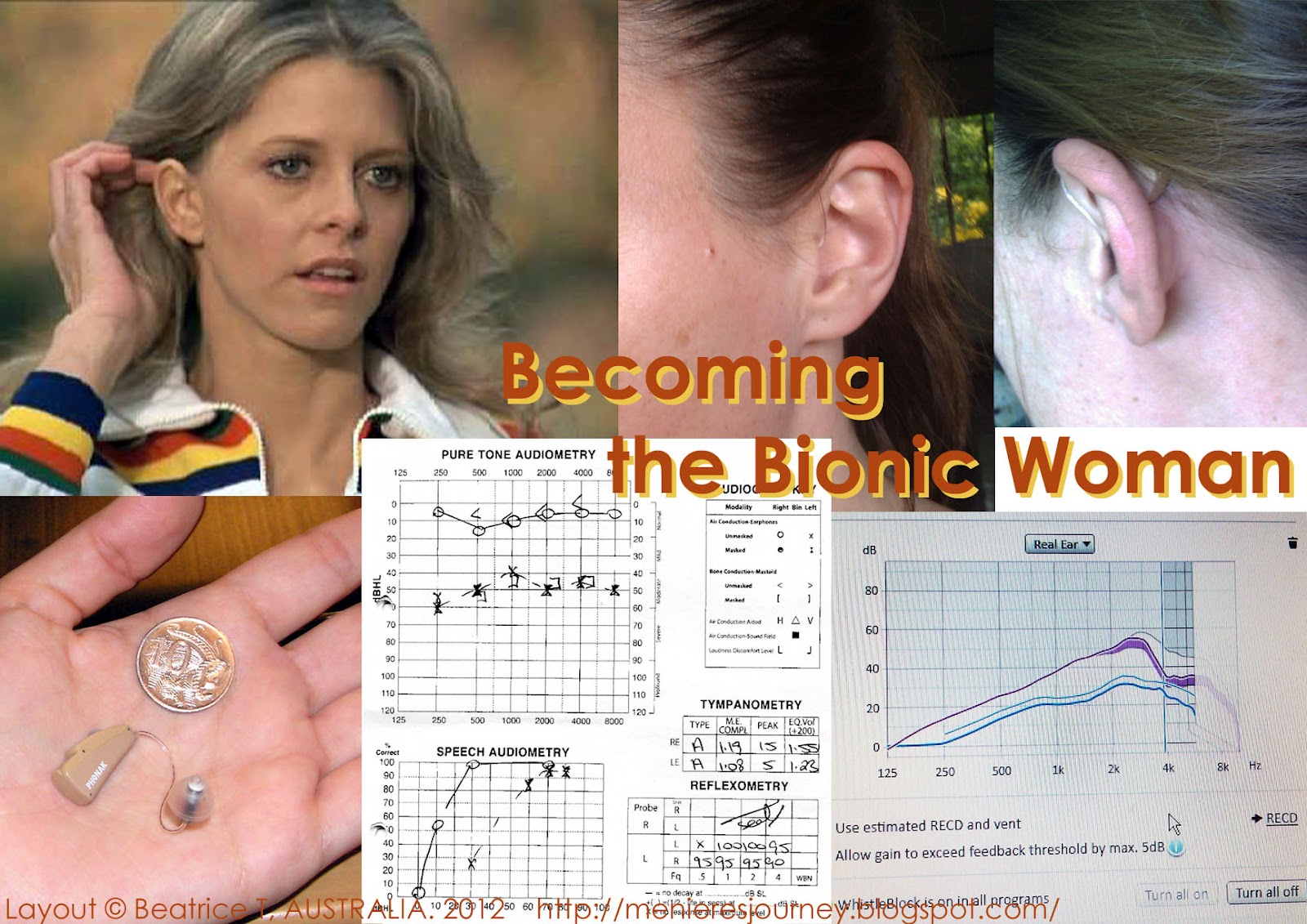
It’s been many years since I’ve watched an episode of The Bionic Woman. As a child I would be glued to the TV enthralled by the super human qualities of character Jaime Sommers, a tennis pro that nearly died in a skydiving accident only to be “re-built” with a bionic right ear, a strengthened right arm and enhanced performance legs. The catchphrase was, “We can rebuild her… we have the technology”.

As much as I would love to be able to crush a tennis ball with my right hand, or run up to 60 miles per hour (about 96km), I would quite happily settle for the bionic ear. Thanks to Meniere’s Disease I’m more like some character from the Beverly Hills Hillbillies with an ear trumpet, “What’s that sonny? Speak into the ear horn!!”

But luckily this isn’t 1976. We’re living in “THE FUTURE”, so what cost six million dollars in the seventies would surely be available and affordable now. Right? Well not quite.  Thirty six years on a top-of-the-line hearing aid will put you back about AUD$4,300 to $5,000 (for a single aid, not including fitting). It’s not the implanted variety that the Bionic Woman had, but its close.

Last week I went to my hearing specialist, at the Neurosensory Unit in Brisbane, for an audiogram specifically to fit me for a trial hearing aid.

My audiologist, Michelle Nicholls, took me through the usual audiogram (anyone with Meniere’s would be familiar with this test). After the test she asked me what type of outcome I was looking for; specifically if I wanted to hear a wide range of sounds or primarily just speech. Apparently older recipients of hearing aids prefer to hear speech without the addition of the ambient noise that surrounds us.

As a young-ish person with Menieres, of course I wanted to be able to hear speech better but I also wanted to be able to hear music better and all the richness of the sounds that surround us. I wanted to feel more a part of my surroundings as I had before I started to lose my hearing. Also I wanted to be better able to orientate myself with sound. ( If I ask somebody in another room where they are, they invariably say, “I’m here!”. “Here? Where exactly is here?” “I can’t tell anymore because I’m going deaf in one ear and can’t pinpoint where “here” is.”) But most of all I wanted to be able to hear the very low frequency pitch, like the low, guttural sounds of my cat purring (between 25 and 150 Hertz). Once I have that sound back I’ll be happy.

Based on my requirements and my moderate, unilateral hearing loss diagnosis, Michelle selected a hearing aid she believed would be suitable. She selected the Phonak  Audéo S IX SMART (a micro Behind-The-Ear model) for trialling with the expectation that if it worked well I could look at getting a Phonak Nano Ambra (a Custom In-The-Ear model) which essentially has the same features as the S IX SMART but is neatly concealed in the ear canal.

I tried the Phonak  Audéo S IX SMART on my left Meniere ear and Michelle took me through the Real Ear Test. She asked me questions, I provided her with feedback, then she would make some adjustments through her computer (see bottom right pic above) and we’d repeat the process. Once we were satisfied that I had the optimum level, I was released back into the wild with my “bionic” ear.

On my way out through the reception I was suddenly very aware of the sound around me. It felt like somewhere in the room there was a concealed microphone and speakers, like a subtle PA system. I heard the whir of the ducted air conditioner above, which I had not previously noticed. So this is what it’s like to be bionic.

In the busy café downstairs I approached the cashier to place my decaf coffee order. I felt so much more tuned into what was happening; people chatting behind me, music coming from the speakers above and most importantly the cashier asking me to place an order, which I did. I could feel myself smiling because of my bionic secret. I was mindful to compose myself so as not to appear weird but as I looked down I “heard” the cashier ask me if I wanted a receipt. I looked up and with a beaming smile I said, “Yes. Yes I would love a receipt.”  Knowing that my fascination for the rediscovered world of sound was spilling over, I came clean and said, “I’ve just been fitted with a hearing aid, so I’m feeling pretty pleased at the moment because I can hear things I haven’t heard for a while.” The cashier was inquisitive and tried to spot the device in my ear saying, ”It’s not very noticeable”. Yay! (See pictures above.)

Over the past week of trialling the Phonak Audéo S IX SMART I’ve had similar moments of awe but have remained more contained in my outward persona. I even went on a first date with a fellow who was none the wiser of the presence of hearing assistance, which was great because that’s not the sort of conversation I want to have on a first date. I’ll save that for the honeymoon ;-) (Just kidding folks.)

I haven’t been wearing the hearing aid all day. Obviously it can’t be worn in the shower or while sleeping in bed. When not in use I’ve kept the device next to my bed. In the morning I click the battery hatch door into place and put the device in my ear where it stays until about late afternoon. It’s been great for chatting with my flatmate, watching television and listening to music (without headsets as it would get in the way, although there is a Phonak accessory for that). It’s been particularly good for being out and about, shopping, in cafes, and hearing ambient noise to help orientate myself. I’ve even had a few “bionic” moments, hearing conversations normally out of range.

On the negative side, I tried to have a phone conversation using the Meniere ear and although there was some improvement I found it easier just to revert to my good ear. I also find that by mid-afternoon I’ve been taking the hearing aid off for a while as it begins to feel heavy (like wearing chandelier earrings for a few hours) even though it weighs next to nothing. Also if I brush my hair back behind my ear with my fingers there is a prominent microphone sound, like if you were to brush your hand over a regular microphone (“testing… one, two, three”). The same thing occurs when wearing sunglasses. That can be a little annoying however this wouldn’t be an issue with a Custom In-The-Ear model. And last but not least, I haven’t found it particularly effective in hearing the low frequencies of a cat purr (sigh!). That could be partly to do with the position of the microphone behind the ear, so an In-The-Ear model might be better for that.

Overall I feel it has been a beneficial experience. I’ve found that although my hearing is not back completely, there is enough of an improvement to make daily activities more tolerable and even enjoyable. Now all I have to do is find the funding for the Phonak Nano Ambra. Oh, well… at least it’s not $6million.

HAVE YOU BEEN FITTED WITH A HEARING AID BECAUSE OF MENIERE’S DISEASE? IF SO, SHARE YOUR EXPERIENCES BELOW.

WATCH Lindsay Wagner as The Bionic Woman

Bionic Woman Intro

Bionic Woman's Ear Problem

MORE ABOUT THE HEARING AIDS BELOW:

Phonak Audéo S IX SMART 
Features & Benefits
Acoustically Optimized Vent (AOV) - Minimum occlusion
DuoPhone - With the push of a button, the phone signal is heard in both ears
EchoBlock - Understand well in echoey environments
FlexControl - Easy interaction with the hearing system
FlexVolume - Controls that allow the wearer to easily make targeted adjustments
NoiseBlock - Premium comfort in background noise
QuickSync - Control both instruments with one touch
Real Ear Sound - Natural sound orientation
SoundFlow - Continuous and instant optimization to all environments
SoundRecover - Awareness of the sound environment and listening pleasure
SoundRelax - Eliminating annoying sounds
WhistleBlock - Feedback free hearing
WindBlock - Suppresses wind noise
ZoomControl - Ability to choose the hearing focus 
WaterResistant - Water, sweat, moisture and dust resistant! 
StereoZoom - In an extremely noisy situation where you want to communicate with just one person, StereoZoom can zoom in even closer and reduce noise even further. 
Auto ZoomControl - When you cannot easily face the speaker, e.g. in a car, auto ZoomControl can zoom to either side and backwards for effortless understanding.
UltraZoom Premium - In noisy situations with several people talking around you, UltraZoom automatically zooms to the voices coming from the front. Noise from the side and back is reduced.

Phonak Nano Ambra
Features & Benefits
Acoustically Optimized Vent (AOV) - Minimum occlusion
DuoPhone - With the push of a button, the phone signal is heard in both ears
EchoBlock - Understand well in echoey environments
FlexControl - Easy interaction with the hearing system
NoiseBlock - Premium comfort in background noise
QuickSync - Control both instruments with one touch
Real Ear Sound - Natural sound orientation
SoundFlow - Continuous and instant optimization to all environments
SoundRecover - Awareness of the sound environment and listening pleasure
SoundRelax - Eliminating annoying sounds
WhistleBlock - Feedback free hearing
WindBlock - Suppresses wind noise
ZoomControl - Ability to choose the hearing focus 
WaterResistant - Water, sweat, moisture and dust resistant! 
StereoZoom - In an extremely noisy situation where you want to communicate with just one person, StereoZoom can zoom in even closer and reduce noise even further. 
Auto ZoomControl - When you cannot easily face the speaker, e.g. in a car, auto ZoomControl can zoom to either side and backwards for effortless understanding.
UltraZoom Premium - In noisy situations with several people talking around you, UltraZoom automatically zooms to the voices coming from the front. Noise from the side and back is reduced.

Accessories and FM’s
Phonak have optional wireless accessories for TV, telephone, MP3 player, GPS and computers such as ComPilot, TVLink S, PilotOne and iCom – TVLink.